
AI, discrimination, and compounding Bias 😟Being a woman of colour from an island worries me
Understanding AI Bias and its impacts - How to detect and prevent bias in AI

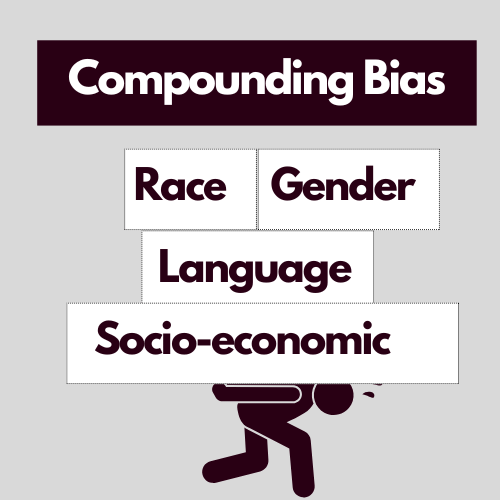
Being a woman of colour, from a minority background, growing up on a post-colonial island where the primary language is a local spoken language (Reunionese Creole 🇷🇪) always gave me a different yet positive perspective of the world. But, hearing about those countless AI bias incidents, that same thing somehow worries me.
AI bias incident harm not only their reputation
After reading about the Facebook case in Brian Christian’s book The Alignment Problem, I felt incredibly frustrated and honestly, powerless. 😔 All I could do was talk about it, share my concern, my voice, hoping that maybe, just maybe, it would spark reflection in even one person’s mind.
Every time I read about AI bias or algorithmic discrimination, it hits somewhere deep, I often think it could have been me. (Side note: Seriously, highly recommend this book if you're diving into AI Bias.)
You've probably heard about Amazon’s infamous hiring algorithm filtering out female applicants. But have you heard about Twitter/X’s image-cropping tool that favored lighter skin? Or Facebook's shockingly racist labelling system? I am talking here about labelling a human being as a primate! What about Uber Eats’ facial recognition failure?
🥺 Imagine if one day you or someone you love had to go through this?
A biased and inequitable AI system isn’t just a technical failure: it causes harm to real people. It breaks trust. It triggers outrage and creates emotional wounds. And yes, it often comes with legal, reputational, and financial consequences.
But more than anything: AI should not cause harm.
An inevitable tale?
First, how do you assess whether your AI model or system is biased?
You don’t need to check if it is! You should assume it is.
As we will highlight later, bias can come from the training data but not only. ML models (complex black-box neural networks) often lack transparency. Even when you try your best to create a fair, representative dataset, bias still finds a way in—through underrepresentation, systemic patterns, or inherited historical imbalances.
Take for example the issue which rose from the discrepancies in detecting faces of black women. Lack of diverse representation on data corpus available for training created biased foundational models. Those same foundational models and their flaws were carried over into countless downstream applications. Whether your own data is biased, or the model you’re using, the result will be unavoidable: a biased AI model. Some renowned scientists have made incredible progress in addressing these issues but this is far from a solved case. Huge thanks to pioneers like Joy Buolamwini and Timnit Gebru, whose work continues to push the field toward accountability and fairness.
Another interesting issue was brought up by Brittne Kakulla on the fine line between “digital stereotype” and “personalization. While valid points were brought up in the comment section of her LinkedIn Post, this would still fall within AI bias as a result of human interaction.
How to detect AI bias
The real first step is to detect how your tools are discriminating or harmful. So now, AI systems are working ethically and equitably?
What is an AI Bias?
➡️ Bias is defined as a systematic error in decision-making processes that results in unfair outcomes and can arise from different sources: data (pre-existing bias), algorithm (technical bias), and human (emerging bias).
When talking about data, it could be due to an underrepresented group in the training data, biased data = biased AI. Bias is much more complex than just this and there are many form of biases: sampling bias, algorithm bias, interaction bias, confirmation bias, measurement biais… The reason we want to address bias is to prevent harm to individuals based on factor such as their race, origin, age, gender, sexual orientation, speech, disability.
How to identify a bias in your AI model/system?
AI bias detection is not a one time get it done thing. Preventing AI bias, together with building a responsible, fair and trustworthy AI, should be integrated from the start of the AI lifecycle.
This means you should mitigate AI bias at all stages of the AI development: from data collection stage (pre-processing, selection, augmentation), model selection, training process to the post-processing/monitoring phase.
A lot of open source tools are also available to detect and mitigate AI bias such as What-If from Google or AI Fairness 360 from IBM.
Preventive over reactive
🔄 Again, the best way to act upon AI bias is to have a preventive approach: avoiding unnecessary harm to groups or individuals and loss of public trust.
🧬 About Purple Mirror
Purple Mirror is a speculative lens on what the future could look like—if disruptive technologies were designed with human values in mind.
Think of Black Mirror with a twist
I publish multiple time per month the⚡ Daily Glitch ⚡
A bite-sized ethical scenario
Each Glitch is a mini thought experiment—a weird, thrilling, or uncomfortable “what-if” from the near future. You get a scene, a dilemma, and a chance to vote or respond. The most engaging Glitch of the month becomes a full Purple Mirror case study.
One minute of reading. One vote. One step into tomorrow.
Resources:
Alvarez, J. M., Bringas Colmenarejo, A., Elobaid, A., Fabbrizzi, S., Fahimi, M., Ferrara, A., Ghodsi, S., Mougan, C., Papageorgiou, I., Reyero, P., Russo, M., Scott, K. M., State, L., Zhao, X., & Ruggieri, S. (2024). Policy advice and best practices on bias and fairness in AI. Ethics and Information Technology, 26(31). https://doi.org/10.1007/s10676-024-09746-w
Christian, B. (2020). The alignment problem: Machine learning and human values. W. W. Norton & Company.
Ferrara, E. (2024). Fairness and bias in artificial intelligence: A brief survey of sources, impacts, and mitigation strategies. Sci, 6(1), 3.https://doi.org/10.3390/sci6010003